GrantTune is exploring whether a language model adapted to a focused scientific literature can become a more useful research collaborator. Our first case study concerns tRNA biology, translation stress, and proteostasis—the maintenance of a functional protein population. A small adaptation experiment improved held-out scientific-text prediction. In one subsequent answer pair, our editorial assessment found the adapted model’s questions more thematically connected. Whether that concentration reflects better scientific judgment, narrower coverage, or both remains untested.
The opportunity is practical: scientists can bring literature and difficult questions, inspect how adaptation changes the answers, and help define what useful expertise looks like.
01Evaluating the choice of research questions
A model can produce a plausible explanation without helping a laboratory decide what to investigate next. Research choices also require judgments about importance, unresolved mechanisms, available experiments, and the value of competing directions. We use “scientific taste” as shorthand for those judgments.
Dr. Raghu Chivukula of Massachusetts General Hospital & Harvard Medical School, who supplied the case-study prompt, suggested that question selection could be a more sensitive indicator of expertise than factual recall. This is the motivating hypothesis for the evaluation, not a validated finding. His request asked the model to select three interesting, tractable questions, emphasize human relevance, and address existing puzzles. It therefore probes selection and framing; a stronger prioritization test would additionally require explicit tradeoffs and rejected alternatives.
02Literature adaptation and the GrantTune workflow
The experiment began with an existing instruction-tuned model identified in the run records as Gemma 4 12B, using a pinned 4-bit MLX checkpoint. We updated small low-rank adapters while keeping the base weights frozen. Low-rank adaptation reduces the number of parameters trained; the original LoRA paper describes the underlying approach. Our exact MLX settings and model revision are preserved in the supporting data. Hu et al.; Supporting data.
Training used scientific passages with a next-token prediction objective: the model learned to predict the continuation of paper text. This was domain-adaptive continued pretraining, rather than supervised training on polished grant answers or expert-corrected research proposals. Related studies were grouped for splitting; reference reviews were kept separate from the experimental training, validation, and test sets. Source metadata, hashes, and source-use records were retained. Supporting data.
GrantTune connects this process to a scientist-facing workflow: a paper library, recorded training runs, paired model comparisons, and saved notes and corrections. Discovery review adds evidence-linked claims and proposed directions for criticism. Expert correction and a separate decision about data use precede any future training on those corrections. The current study demonstrates a local model experiment connected to a hosted review interface.
03Training results
Table 1. The literature adaptation experiment used for the case study. Values come from the frozen manifest, adapter configuration, and completed run logs. Supporting data.
| Component | Recorded value |
|---|---|
| Training set | 15 primary papers; 152 passages; 132,265 tokens |
| Validation set | 1 paper; 17 passages; 14,505 tokens |
| Held-out test set | 2 papers; 33 passages; 29,220 tokens |
| Update configuration | 4 adapted layers; rank 8; query and output projections |
| Training schedule | 152 updates; one pass; learning rate 0.000005 |
| Batch and sequence budget | Batch size 1; maximum 1,024 tokens; gradient checkpointing |
| Hardware and runtime | Apple M4 with 24 GiB memory; MLX 0.32.3 and MLX LM 0.32.0 |
| Observed training throughput | Approximately 82–83 tokens per second |
| Validation loss | 6.594 initially → 3.803 finally |
| Held-out text loss | Baseline 6.858 → adapted 3.894 |
| Held-out perplexity | Baseline 951.710 → adapted 49.088 |
Loss penalizes the model for assigning low probability to the text that actually follows; lower values indicate better prediction under the same evaluation procedure. The reported perplexities are the values printed by MLX, rather than values recomputed from rounded losses.
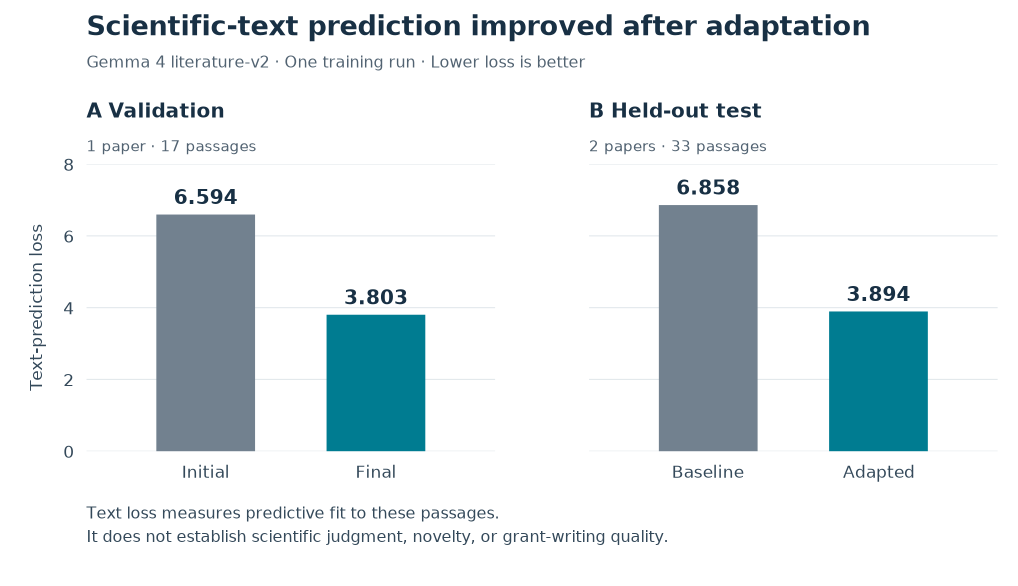
The result establishes better prediction on this small held-out text set. It does not measure the quality of an experimental design or establish improved scientific reasoning. The test covers only two papers, public literature may have appeared in base-model training, and the holdout has now been inspected. There are no repeated training runs or uncertainty estimates here. Absolute losses should not be compared across different model/tokenizer setups or different evaluation corpora.
04A scientist supplied question
On 9 October 2026, the platform recorded the following prompt with no additional context:
What are the 3 most interesting, tractable scientific questions regarding mammalian tRNA processing and translation stress based upon your understanding of the literature? Emphasis should be placed on problems with relevance to human biology/disease and resolve previous paradoxes or mysteries in the field(s).
Both models received the same prompt, temperature 0, seed 0, thinking disabled, and a 1,200-token output budget. The baseline produced 1,014 output tokens in approximately 80 seconds; the adapted model produced 1,001 in approximately 78 seconds. Both stopped normally. These are single recorded timings, not a speed comparison. The paired record links the adapted answer to the same adapter evaluated in Table 1. Supporting data.
Table 2. Research directions selected by each model. These are editorial summaries of unchanged model answers, not validated biological conclusions. Row numbers preserve the order in each answer and do not establish matched topics or explicit priority ranks.
| Position | Baseline selection | Adapted selection |
|---|---|---|
| 1 | Whether stress responses sense tRNA supply or ribosome stalling | Where pauses that assist folding become stalls that trigger quality control |
| 2 | How modification patterns selectively affect disease-associated protein translation | Whether tRNA-related signals initiate stress responses before protein misfolding |
| 3 | Whether tRNA turnover helps determine recovery from proteotoxic stress | How transcripts compete for limited or differently modified tRNA pools |
05What the comparison suggests
The baseline covers a wider agenda, spanning sensing, selective translation, and recovery. The adapted answer concentrates on relationships among translation kinetics, folding, stress signaling, and competition. We interpret this as greater thematic coherence, with a possible tradeoff in breadth. Coherence alone does not establish that the chosen questions are more consequential or better prioritized.
The adapted model’s first question is the clearest example:
What is the specific “Goldilocks” threshold of tRNA-mediated stalling that optimizes protein folding versus triggering the ribosome-associated quality control (RQC) pathway?
That question gives an expert a useful tension to refine, but its broad premise already has substantial precedent. Juszkiewicz and colleagues showed that ZNF598 recognizes collided ribosomes and that translation initiation rate helps determine a substrate-specific threshold for quality control. Juszkiewicz et al.. Nedialkova and Leidel linked tRNA modification defects to altered decoding and protein aggregation in yeast and nematodes. Nedialkova and Leidel. Both papers were in the training set. The proposal needs to identify a remaining gap in a defined mammalian setting and an experiment that distinguishes competing explanations. Its potential value lies in helping formulate that next test; the present answer does not establish novelty. Supporting data.
The remaining proposals show why attractive framing still requires criticism. Both answers portray aspects of tRNA-versus-ribosome stress sensing as broadly unresolved without situating them in established GCN2 research. Inglis and colleagues demonstrated activation of human GCN2 by ribosomes and the ribosomal P-stalk in vitro; a useful follow-up must identify what remains unresolved beyond that evidence. Inglis et al..
Tractability also needs more than naming assays. The adapted answer suggests SUnSET to follow translation inhibition, but SUnSET measures global protein synthesis and does not itself identify which upstream signal initiated the response. Similarly, generic “tRNA-seq” does not specify a validated measurement of every modification; Nano-tRNAseq illustrates the specialized methods and processing needed to estimate abundance and modification dynamics. Schmidt et al.; Lucas et al..
Both outputs contain wording defects. The baseline includes a stray image-token marker; the adapted answer includes malformed phrases such as “or or-specific.” These remain in the original answers in the supporting data. In an earlier six-question development batch, 11 of 12 answers finished normally and one became repetitive and reached its token limit. Mechanical completion and improved text loss therefore cannot substitute for scientific review. Supporting data.
Dr. Chivukula’s initial assessment of the responses was positive, encouraging a broader evaluation of their usefulness to working scientists. This qualitative feedback complements the AI-assisted editorial analysis presented here. A formal assessment of model preference and research-planning value is the next step.
06Measuring scientific usefulness next
The next evaluation should separate factual correctness, research judgment, and writing quality. Before collecting answers, define the rubric, the laboratory’s capabilities and time budget, and a fixed set of questions. Randomize answer order, hide model identities, and obtain independent assessments from multiple domain scientists. Ask each model to choose a first priority, explain why a plausible alternative ranks lower, and propose a discriminating first experiment. Reviewers should assess the scientific content before seeing model labels and retain disagreements rather than force every case into a single winner.
These judgments overlap with NIH’s current R01 review framework, which considers research importance, rigor and feasibility, and whether the team has sufficient expertise and resources. For this pilot, that means asking what resolving a question would change, whether an experiment can distinguish plausible explanations, and whether it fits a laboratory’s capabilities. A basic mechanistic advance can be important without an immediate clinical application, and novelty alone does not establish importance. NIH review framework. Our proposed evaluation would measure usefulness for research planning, not predict funding outcomes.
Table 3. Proposed evaluation measures. These are future measurements, not results from the present pilot.
| Dimension | What reviewers would assess |
|---|---|
| Scientific importance | What would resolving this gap change about understanding or research practice, and is that value supported by prior evidence? |
| Priority judgment | Given the laboratory’s capabilities and time budget, does the model justify its first choice and explain why a plausible alternative ranks lower? |
| Experimental usefulness | Does a feasible first experiment include appropriate controls, distinguish competing explanations, and remain informative if the favored hypothesis is unsupported? |
| Evidence discipline | Does the answer distinguish prior findings, hypotheses, and unresolved claims? |
| Calibration | Does it recognize limits, competing explanations, and results that would weaken its proposal? |
| Practical value | Which answer is preferred, how much correction is needed, and how long does refinement take? |
| Reliability | How often do answers contain scientific errors, corrupted text, repetition, or truncation? |
Preference rates should include ties and neither-answer choices. Error rates need explicit denominators, and time-saving claims need an observed comparison with the scientist’s usual workflow. Expert agreement and variation across questions matter alongside average scores.
07An invitation to participating scientists
GrantTune invites scientists to bring a focused literature collection and a small set of questions that require judgment. Participants can compare baseline and adapted answers, identify errors, and show which distinctions matter in their field. These assessments can guide the next experiments in adaptation and evaluation.
The pilot shows that a modest local adaptation experiment can be connected to an inspectable research workflow. Its central scientific question remains open: when does adaptation help a model choose work that scientists judge worth pursuing? Explore GrantTune.
08References and supporting data
- Hu EJ et al. LoRA: Low-Rank Adaptation of Large Language Models. 2021. Research paper.
- Nedialkova DD, Leidel SA. Optimization of Codon Translation Rates via tRNA Modifications Maintains Proteome Integrity. Cell. 2015;161:1606–1618. PubMed and DOI.
- Inglis AJ et al. Activation of GCN2 by the ribosomal P-stalk. PNAS. 2019;116:4946–4954. Full paper.
- Schmidt EK et al. SUnSET, a nonradioactive method to monitor protein synthesis. Nature Methods. 2009;6:275–277. Publisher.
- Lucas MC et al. Quantitative analysis of tRNA abundance and modifications by nanopore RNA sequencing. Nature Biotechnology. 2024;42:72–86; published online 2023. Publisher.
- GrantTune pilot records. Frozen corpus counts, configuration, model and adapter identities, logged results, and the original paired answers from 9 October 2026. Supporting data. These project records support the experimental results; they are not an external peer-reviewed evaluation.
- Chivukula R. Qualitative feedback on the paired model responses. Personal communication to the project team, documented 13 October 2026.
- Juszkiewicz S et al. ZNF598 Is a Quality Control Sensor of Collided Ribosomes. Molecular Cell. 2018;72:469–481.e7. PubMed and DOI.
- National Institutes of Health. Simplified Peer Review Framework. Applies to R01 and other listed research project grants for application due dates on or after 25 January 2025. Accessed 13 October 2026. NIH guidance.